ICML 2026
TL;DR: Why does Muon's orthogonalization help neural networks? Because it adapts to the row-block-diagonal structure of the Transformer Hessian. In that regime the costly Newton-Schulz step provably collapses to a single row-wise $\ell_2$ normalization, so you get the same update at a fraction of the cost ($\mathcal{O}(mn\cdot\min(m,n)) \to \mathcal{O}(mn)$, a 13 to 44× speedup).
Preconditioned adaptive methods capture rich curvature information of the loss landscape, and the central challenge is balancing preconditioning effectiveness against computational cost. Muon is a strong example. It uses a Newton-Schulz iteration to form the preconditioned update without ever materializing the preconditioning matrix. Even so, its efficiency still leaves room for improvement.
We introduce RMNP (Row-Momentum Normalized Preconditioning), which replaces the Newton-Schulz iteration with a simple row-wise ($d_{\text{in}}$) $\ell_2$ normalization, motivated by the empirically observed diagonal-block structure of the Transformer layer-wise Hessian. We show that, for Transformers, orthogonalization and row-wise $\ell_2$ normalization are asymptotically equivalent. This cuts the per-iteration cost from $\mathcal{O}(mn\cdot\min(m,n))$ to $\mathcal{O}(mn)$ while preserving optimization quality. Theoretically, we establish non-convex convergence guarantees that match the best-known results for Muon and attain minimax-optimal complexity. Across extensive LLM pretraining, RMNP delivers competitive performance while substantially reducing preconditioning wall-clock time.
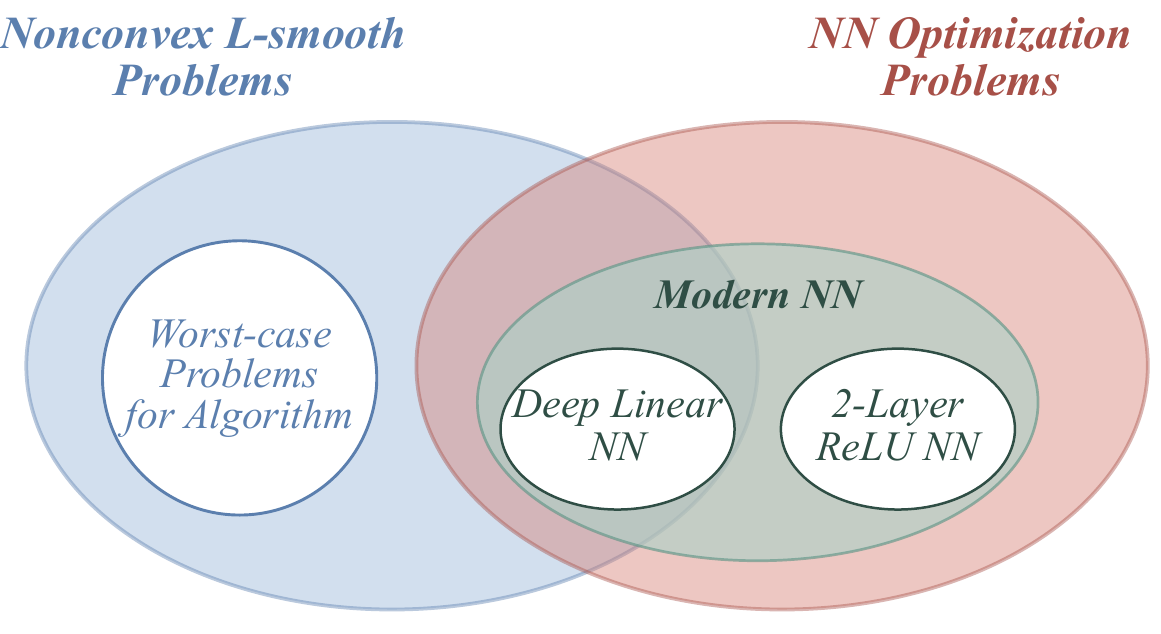
A growing body of work analyzes Muon as an abstract steepest-descent / trust-region method. That view is powerful, but it lives in a worst-case problem class and cannot explain why orthogonalization is specifically suited to neural networks. We instead start from the network's concrete curvature.
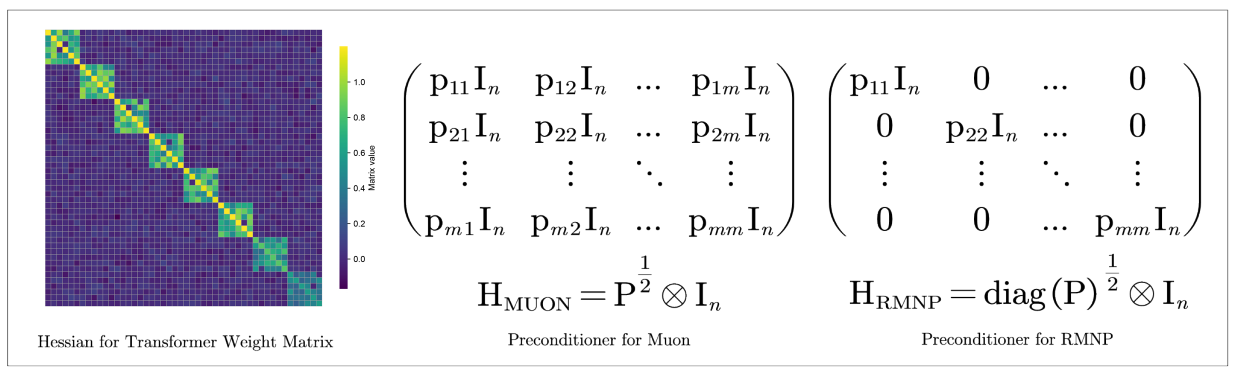
Recent work shows that the layer-wise Hessian of a Transformer is row-block diagonally dominant: unfolded into $m\times m$ blocks of size $n\times n$, the diagonal blocks dominate. By Lemma 4 of Shampoo, Muon descends in the metric
$$ H_{\text{MUON}} = P_t^{1/2}\otimes I_n, \qquad P_t := V_tV_t^\top \in \mathbb{R}^{m\times m}. $$
So $H_{\text{MUON}}$ is block-diagonal precisely when $P_t$ is diagonal. That reduces the whole question to a clean property of the gradient and the momentum:
Question. Is $V_tV_t^\top$ (equivalently $G_tG_t^\top$ at initialization) diagonally dominant for neural-network weight matrices?
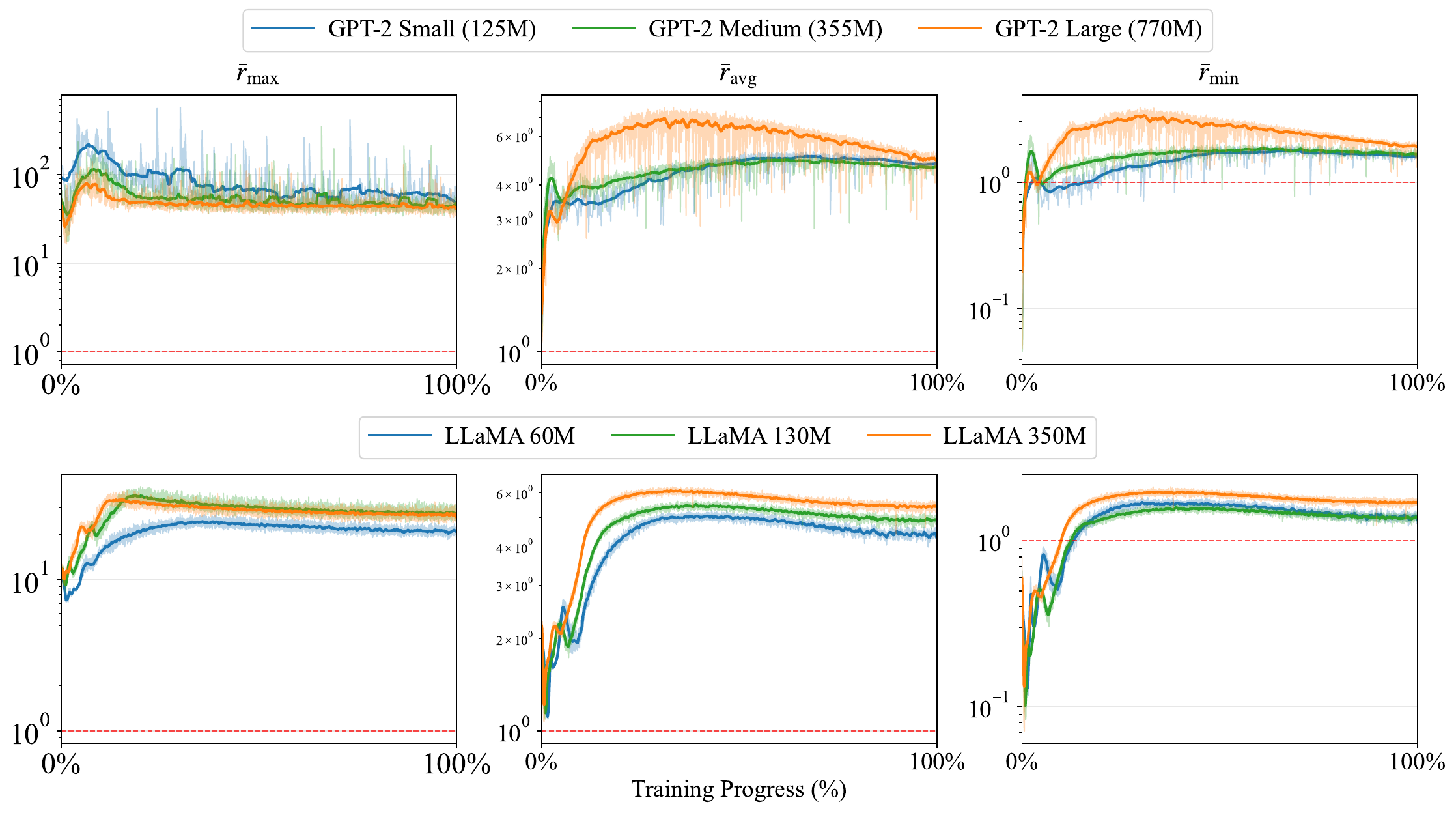
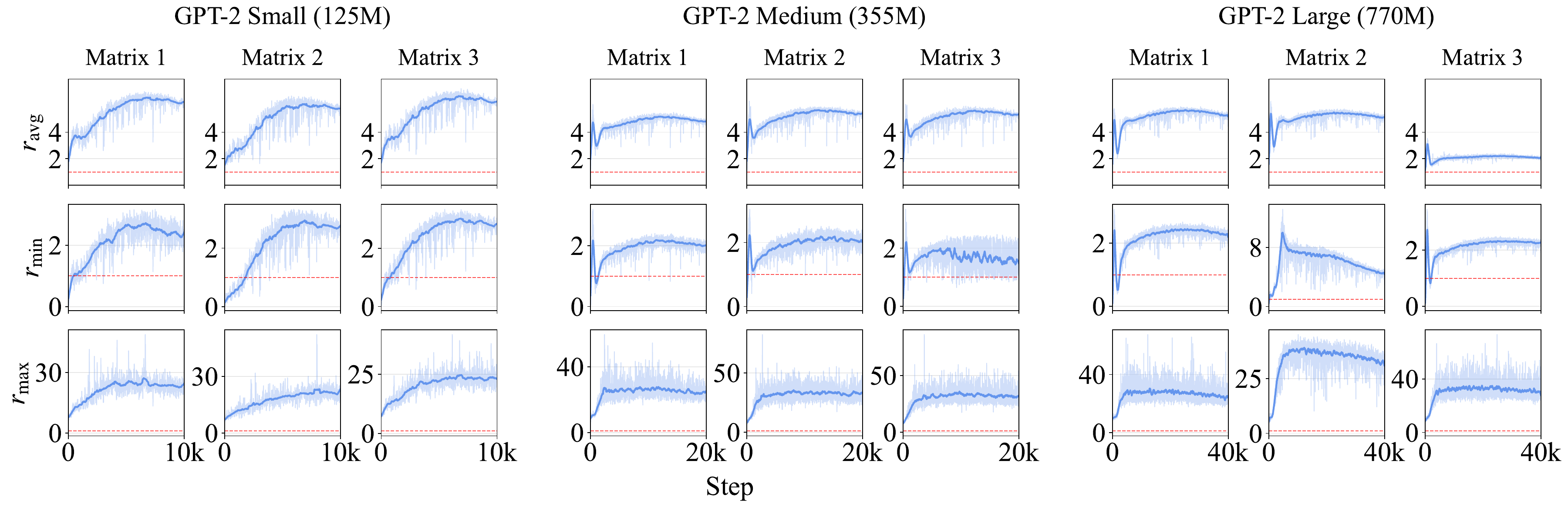
We answer this two ways. First empirically, along the entire training trajectory, and then theoretically, at initialization. Both say yes.
For each row $i$ of the Gram matrix $V_tV_t^\top$ we measure the ratio of the diagonal entry to the average off-diagonal magnitude, $r_i = \dfrac{(V_tV_t^\top)_{ii}}{\frac{1}{m-1}\sum_{j\neq i}\lvert (V_tV_t^\top)_{ij}\rvert}$, and aggregate it into $\overline{r}_{\text{avg}}, \overline{r}_{\min}, \overline{r}_{\max}$. A ratio above $1$ means the diagonal dominates.
🔬 Companion paper · HiLD 2026 Workshop on High-dimensional Learning Dynamics
Worst-case, problem-agnostic analyses cannot explain why a norm fits neural networks, because on the worst case every norm looks equally justified. Real networks occupy a far smaller corner of that problem class, so we analyze the network directly.
At a Gaussian initialization we compute the gradient self outer-product $\mathbb{E}[GG^\top]$ in closed form for three standard settings. In each one, the diagonal entries outgrow the off-diagonal ones as the width grows, so $V_tV_t^\top$ becomes asymptotically diagonal.
| Setting | Diagonal | Off-diagonal | Grows with |
|---|---|---|---|
| Symmetric matrix factorization | $\Theta(k^3)$ | $\Theta(k^2)$ | width $k$ |
| Deep linear, hidden layer $i$ | $\Theta(V_i s_i)$ | $0$ (exactly diagonal) | inner widths |
| Deep linear, output layer | $\Theta(V_L s_L)$ | $\Theta(\prod_{j<L} d_j)$ | inner widths |
| Two-layer ReLU, $W_1$ | $\Theta(d_0 d_2^2 + d_0 d_1 d_2)$ | $\Theta(d_0 d_2)$ | $d_1$ |
| Two-layer ReLU, $W_2$ | $\Theta(d_0^2 d_1^2)$ | $\Theta(d_1)$ | $d_1$ |
Orders of $\mathbb{E}[GG^\top]$ at a Gaussian initialization. In every row the diagonal dominates as the relevant width grows.
Two facts follow from this analysis:
The preconditioner aligns with the Hessian. $P_t=V_tV_t^\top$ becomes diagonal as the width grows, so $H_{\text{MUON}}=P_t^{1/2}\otimes I_n$ becomes block-diagonal in the Hessian's row-block structure.
Orthogonalization is row normalization. When $V_tV_t^\top$ is diagonal, $(V_tV_t^\top)^{-1/2}V_t$ is exactly each row of $V_t$ divided by its own $\ell_2$ norm. Newton-Schulz and row normalization become the same operation, and that is exactly RMNP.
The structure above makes the algorithm almost inevitable: keep the dominant diagonal blocks of the preconditioner and discard the rest. The preconditioned update then reduces to a plain row-wise $\ell_2$ normalization of the momentum matrix:
$$ \left[\left(\operatorname{diag}(V_t V_t^\top)\right)^{-1/2} V_t\right]_{i,:} = \frac{V_{t,i:}}{\sqrt{(V_t V_t^\top)_{ii}}} = \frac{V_{t,i:}}{\lVert V_{t,i:}\rVert_{\ell_2}}. $$
The momentum is the same and so is the matrix-level adaptivity, but now the $\mathcal{O}(mn\cdot\min(m,n))$ orthogonalization becomes an $\mathcal{O}(mn)$ row normalization. Row normalization also needs only a complete row, so it allows column-wise sharding under PyTorch FSDP2 without the all-gather that Muon requires.
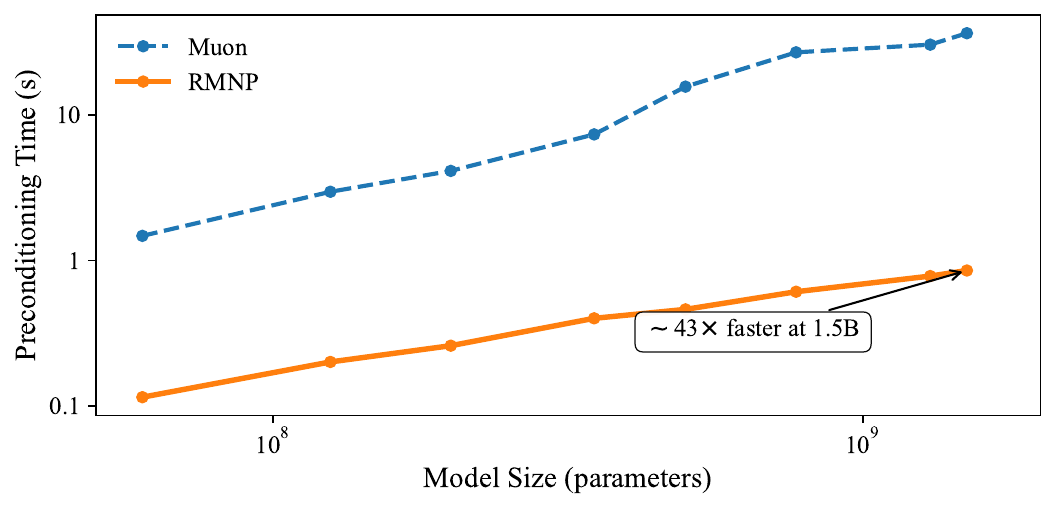
| Model size | Muon (s) | RMNP (s) | Speedup |
|---|---|---|---|
| 60M | 1.480 | 0.115 | 12.9× |
| 125M | 2.975 | 0.201 | 14.8× |
| 200M | 4.140 | 0.260 | 15.9× |
| 355M | 7.380 | 0.401 | 18.4× |
| 500M | 15.720 | 0.462 | 34.0× |
| 770M | 27.070 | 0.611 | 44.3× |
| 1.3B | 30.570 | 0.783 | 39.0× |
| 1.5B | 36.650 | 0.855 | 42.9× |
Preconditioning time over 100 steps, batch size 16, single RTX Pro 6000 GPU.
Under standard non-convex assumptions, RMNP matches the best-known Muon guarantees. Under $\lVert\cdot\rVert_F$-smoothness it attains $\mathcal{O}(m^2 L_F \sigma^2 \Delta \epsilon^{-4})$. Under the matched $\lVert\cdot\rVert_{\infty,2}$-smoothness it improves to $\mathcal{O}(m L_{\infty,2} \sigma^2 \Delta \epsilon^{-4})$, a quadratic gain in the dimension dependence. This mirrors Muon's improvement under nuclear-norm geometry, and it reaches the information-theoretic minimax-optimal rate.
| Method | Smoothness | Criterion | Complexity |
|---|---|---|---|
| Muon | $L_F$ | $\lVert\nabla f\rVert_*$ | $\mathcal{O}(m^2 L\sigma^2\Delta\epsilon^{-4})$ |
| Muon | $L_*$ | $\lVert\nabla f\rVert_*$ | $\mathcal{O}(m L_*\sigma^2\Delta\epsilon^{-4})$ |
| RMNP | $L_F$ | $\lVert\nabla f\rVert_F$ | $\mathcal{O}(m^2 L_F\sigma^2\Delta\epsilon^{-4})$ |
| RMNP | $L_F$ | $\lVert\nabla f\rVert_{1,2}$ | $\mathcal{O}(m^2 L_F\sigma^2\Delta\epsilon^{-4})$ |
| RMNP | $L_{\infty,2}$ | $\lVert\nabla f\rVert_{1,2}$ | $\mathcal{O}(m L_{\infty,2}\sigma^2\Delta\epsilon^{-4})$ |
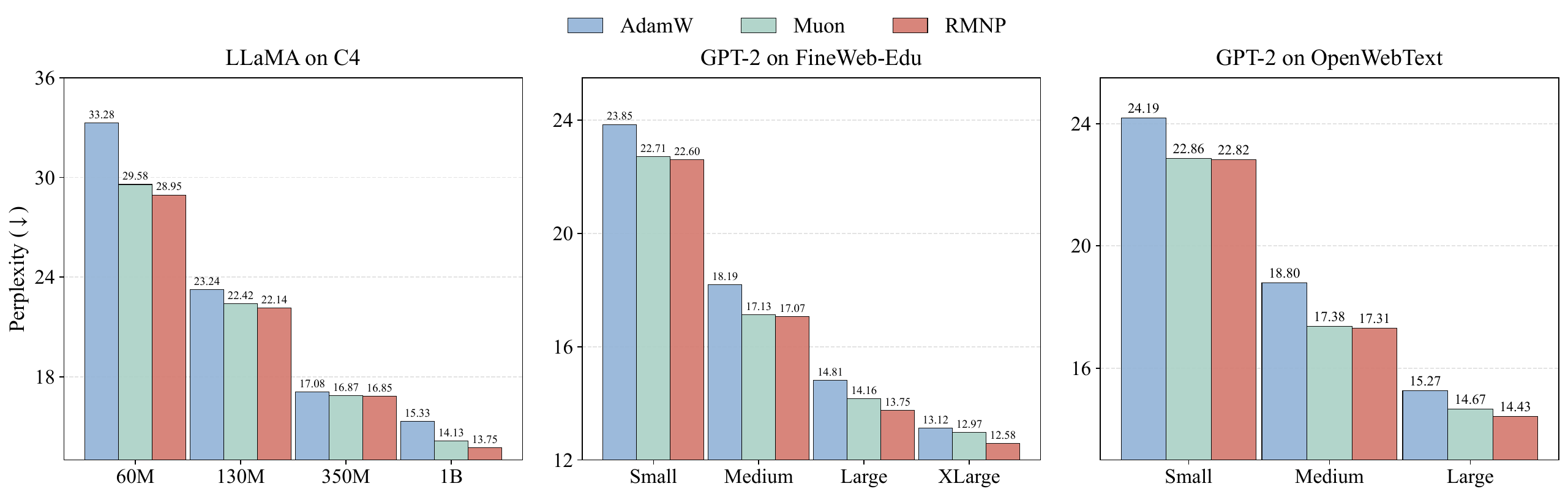
| LLaMA on C4 | GPT-2 on FineWeb-Edu-100B | GPT-2 on OpenWebText | |||||||||
|---|---|---|---|---|---|---|---|---|---|---|---|
| 60M | 130M | 350M | 1B | Small | Medium | Large | XLarge | Small | Medium | Large | |
| AdamW | 33.28 | 23.24 | 17.08 | 15.33 | 23.85 | 18.19 | 14.81 | 13.12 | 24.19 | 18.80 | 15.27 |
| Muon | 29.58 | 22.42 | 16.87 | 14.13 | 22.71 | 17.13 | 14.16 | 12.97 | 22.86 | 17.38 | 14.67 |
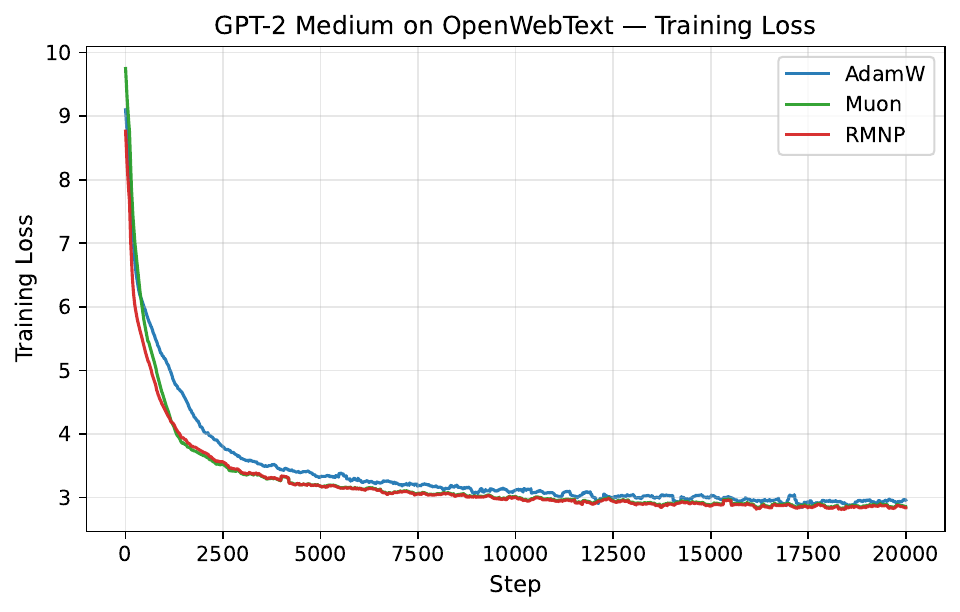
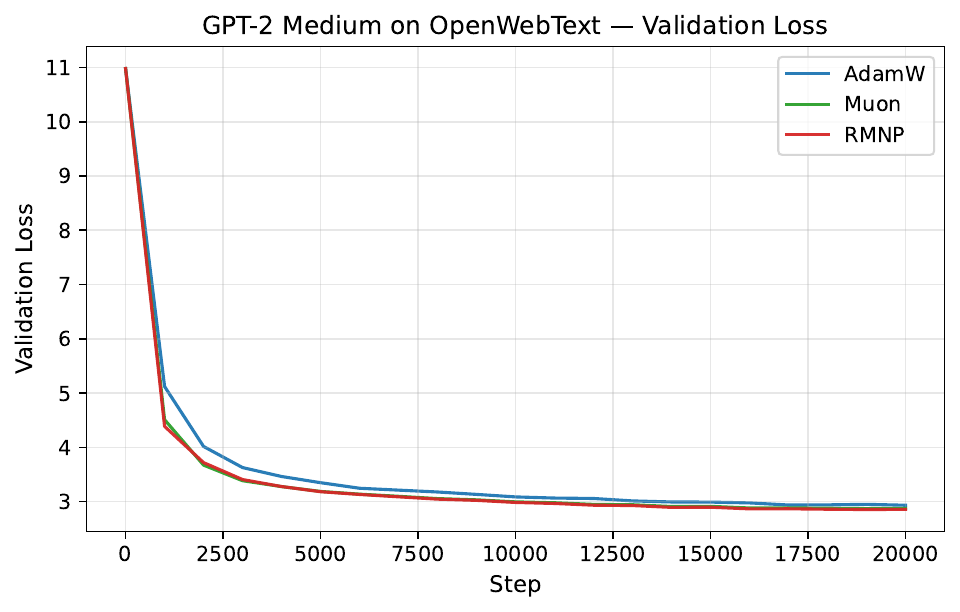
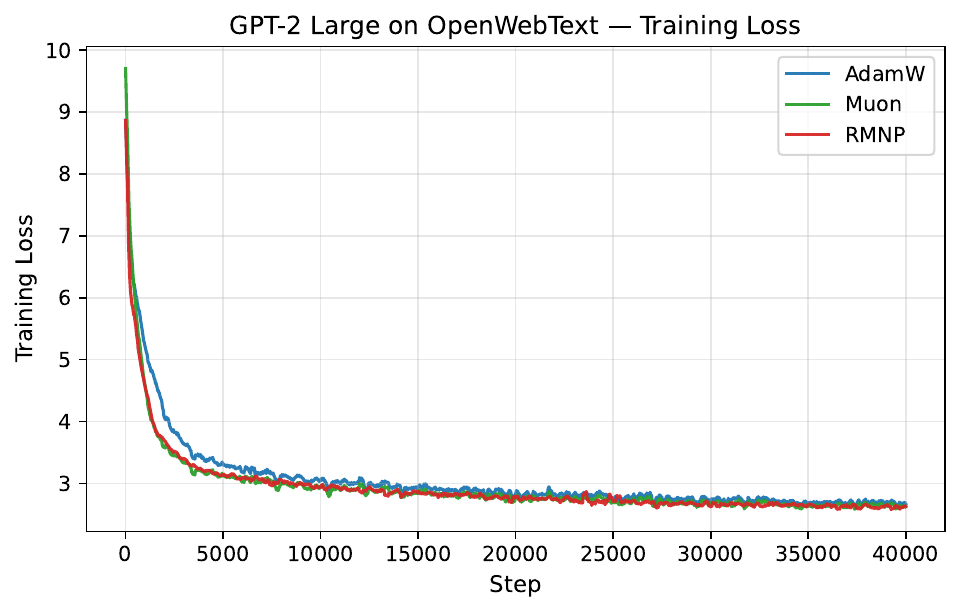
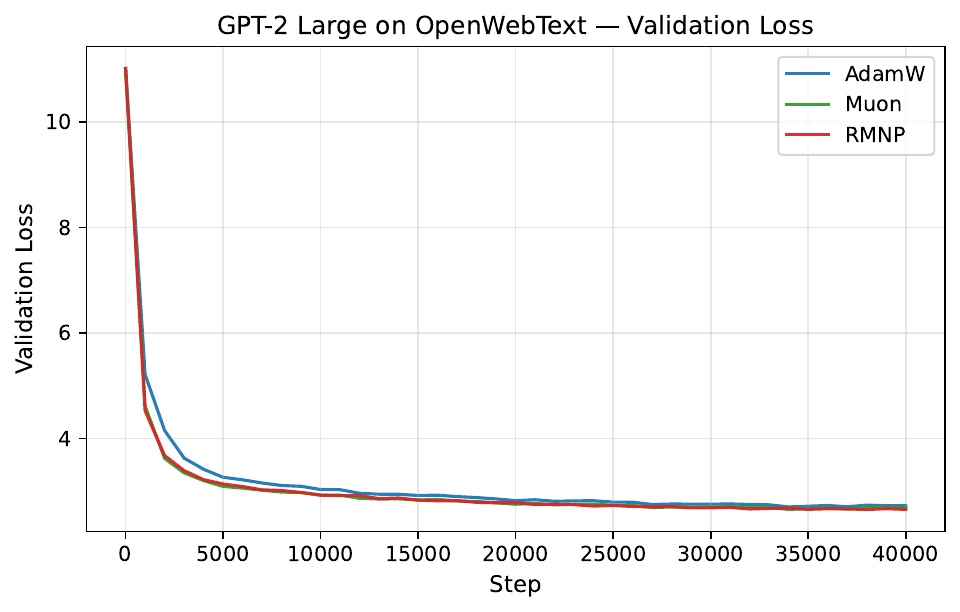
| RMNP | 28.95 | 22.14 | 16.85 | 13.75 | 22.60 | 17.07 | 13.75 | 12.58 | 22.82 | 17.31 | 14.43 |
Final validation perplexity ($\downarrow$). The best value in each column is in bold (Table 17 in the paper).
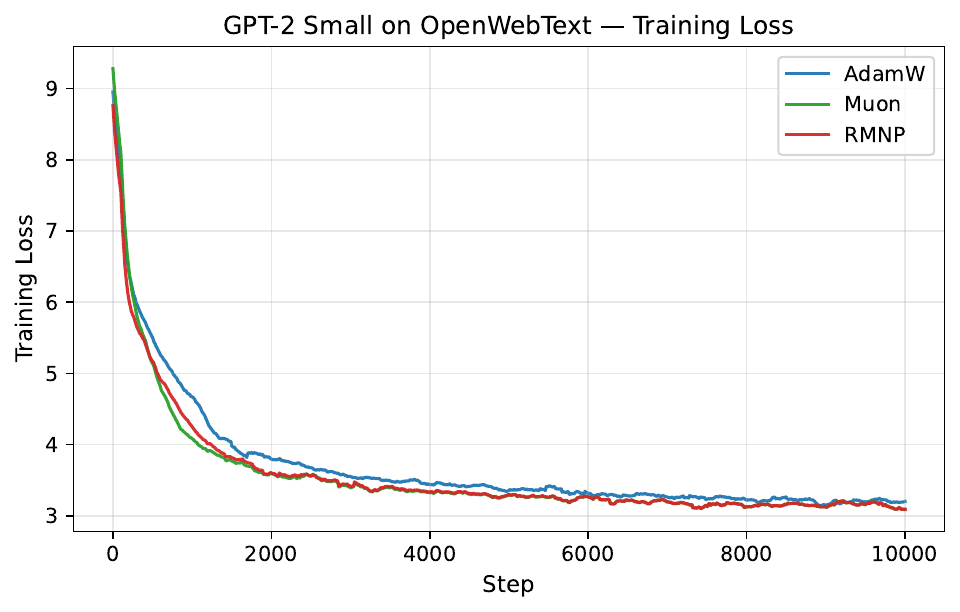
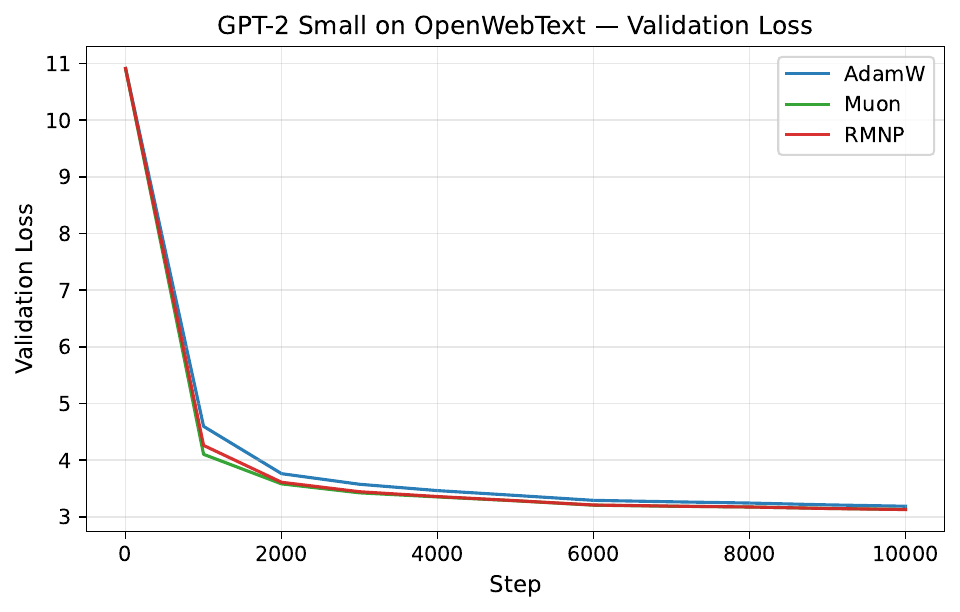
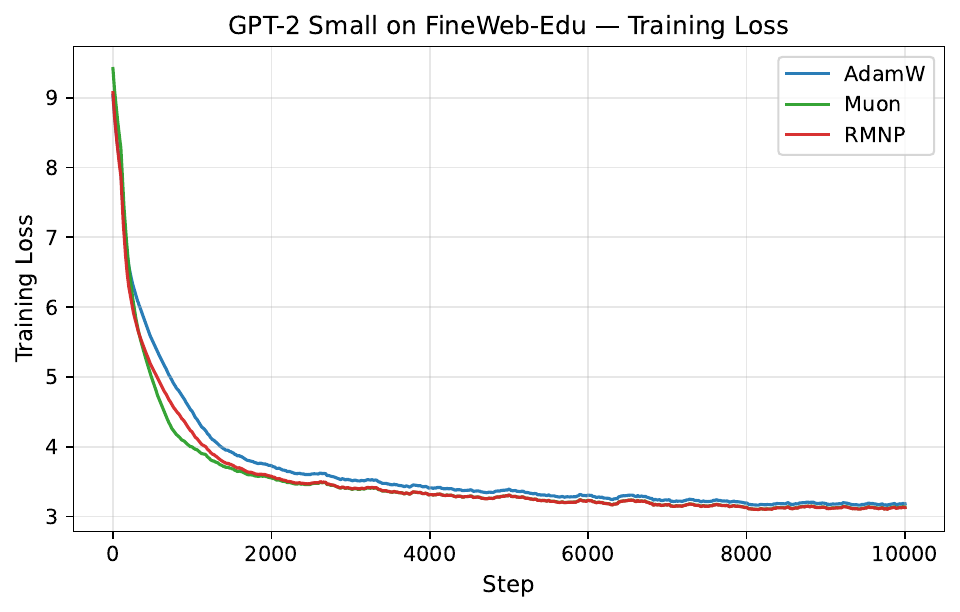
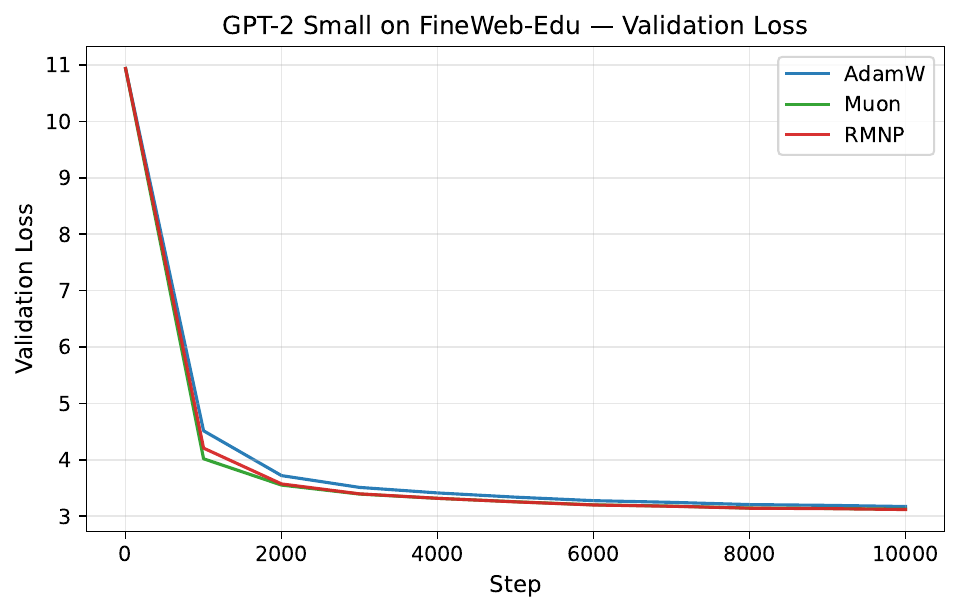
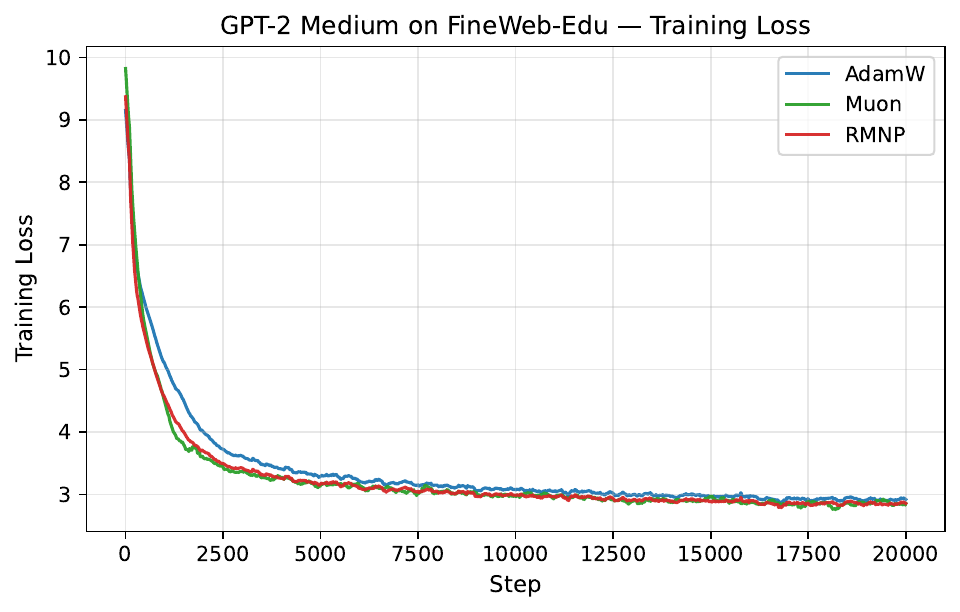
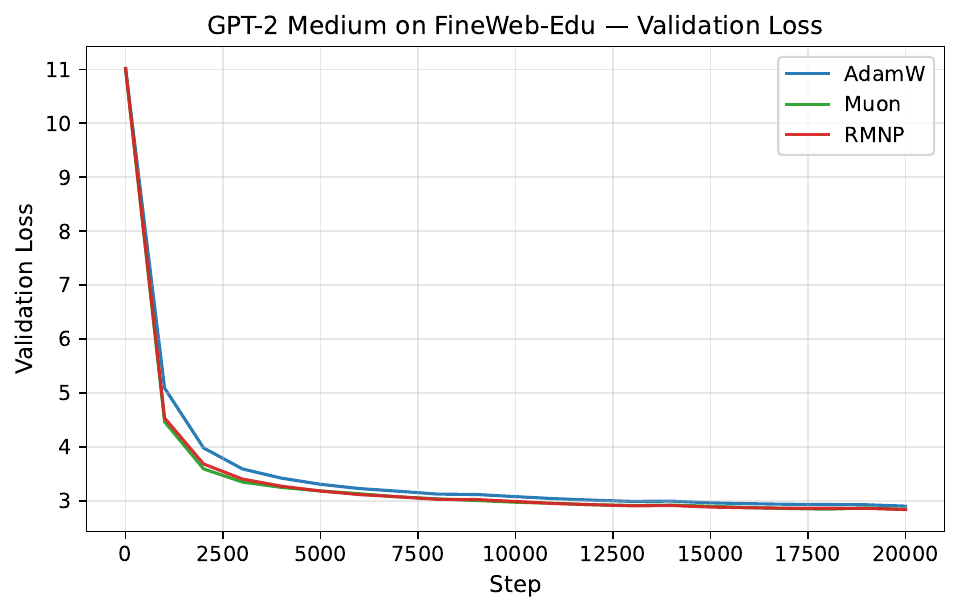
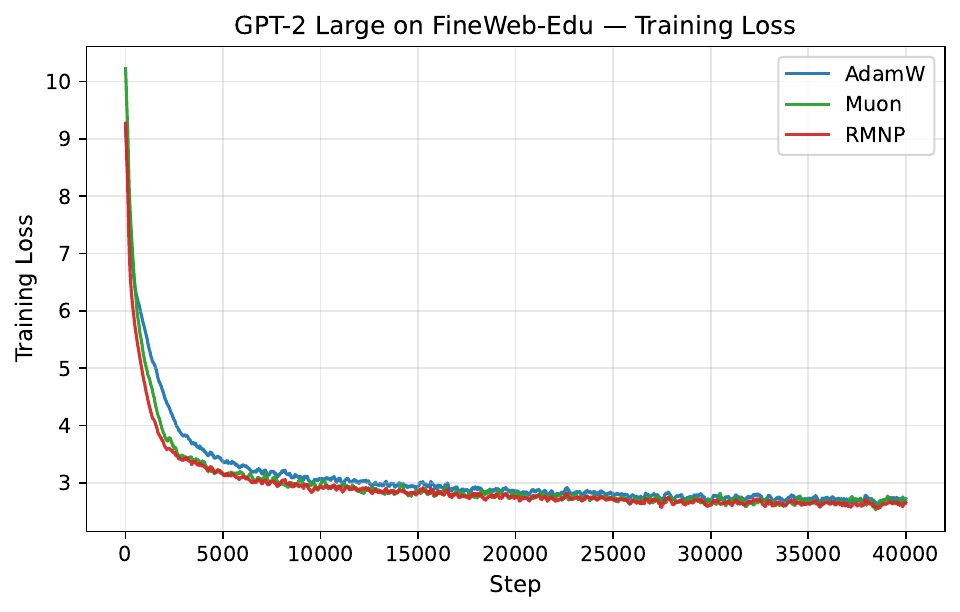
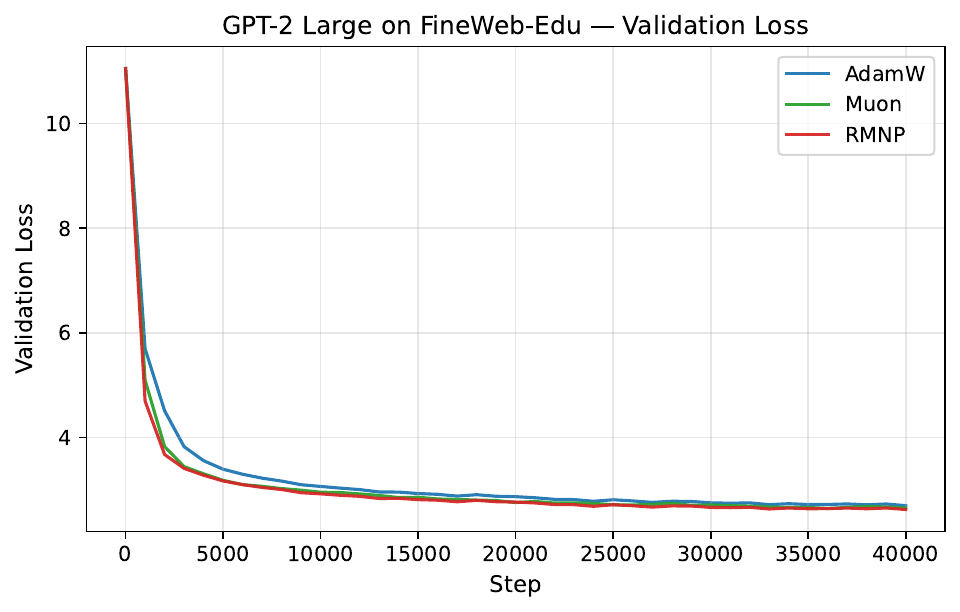
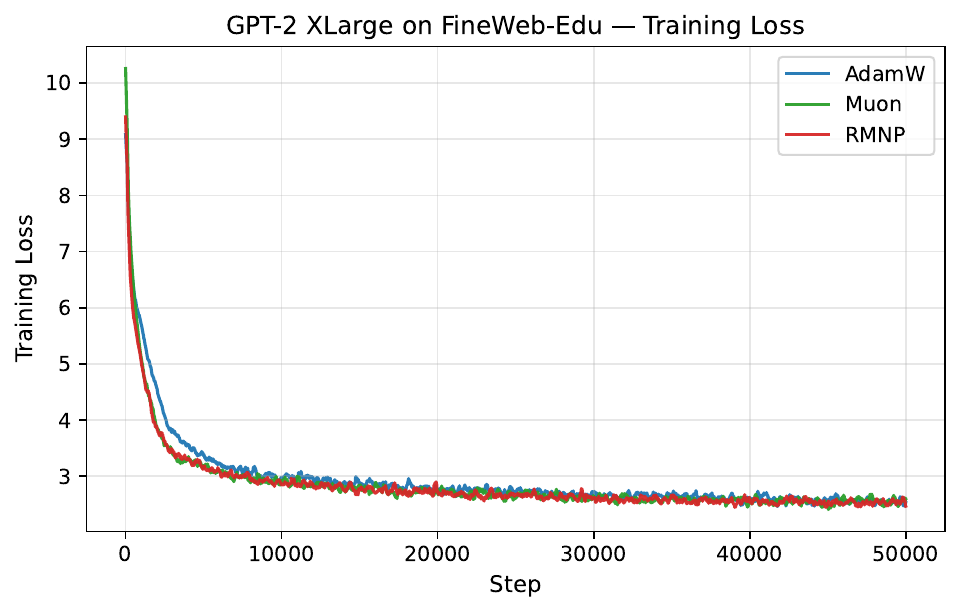
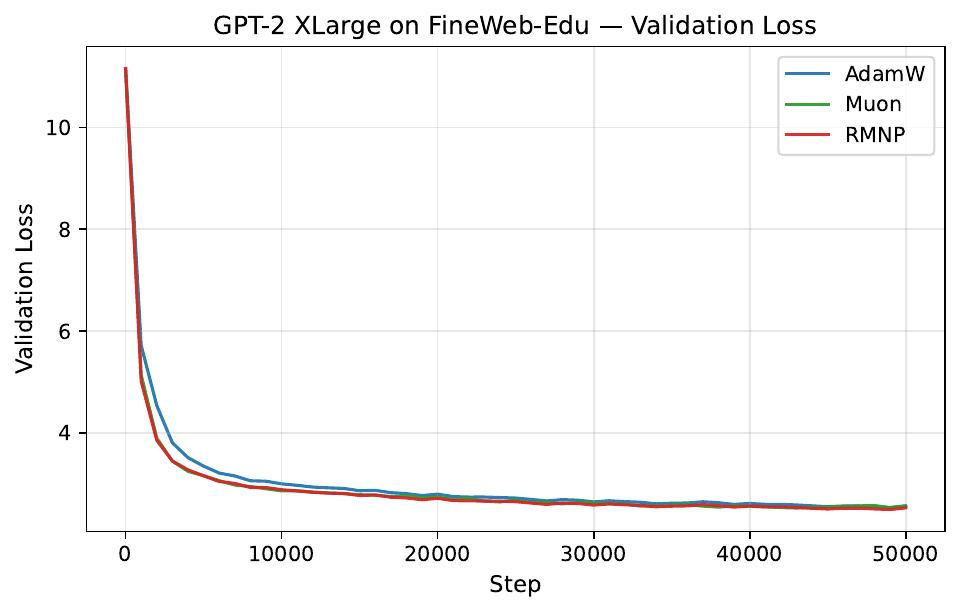
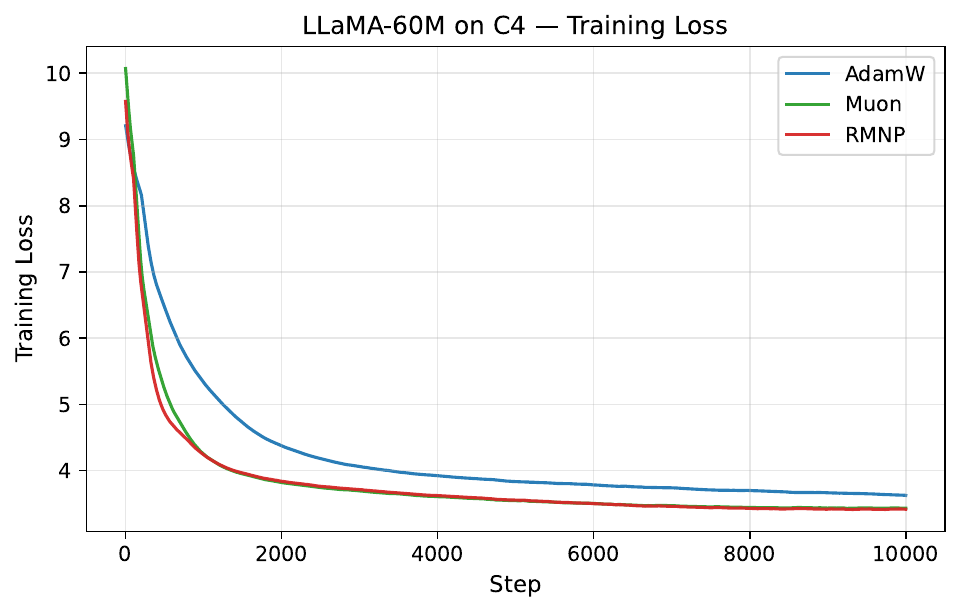
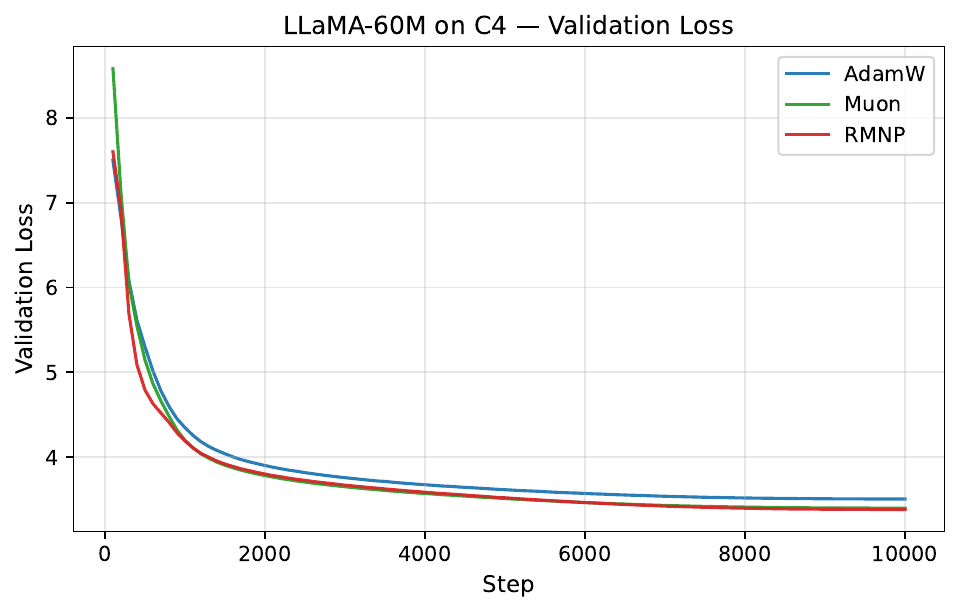
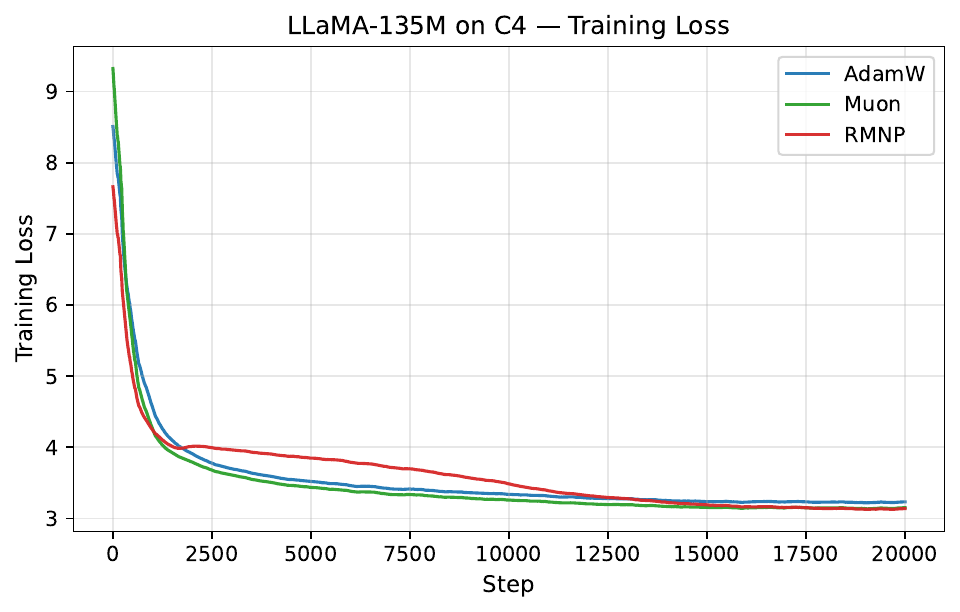
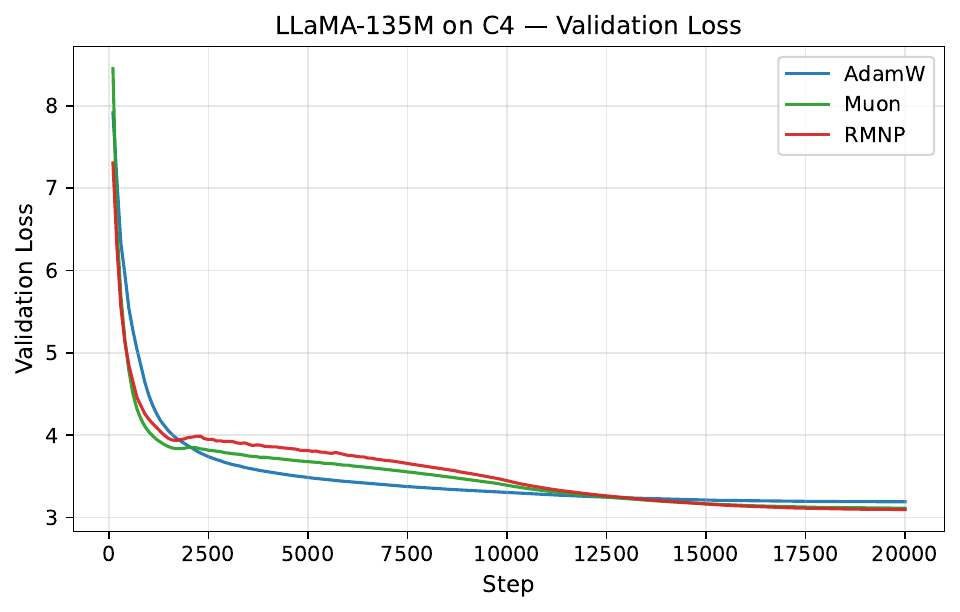
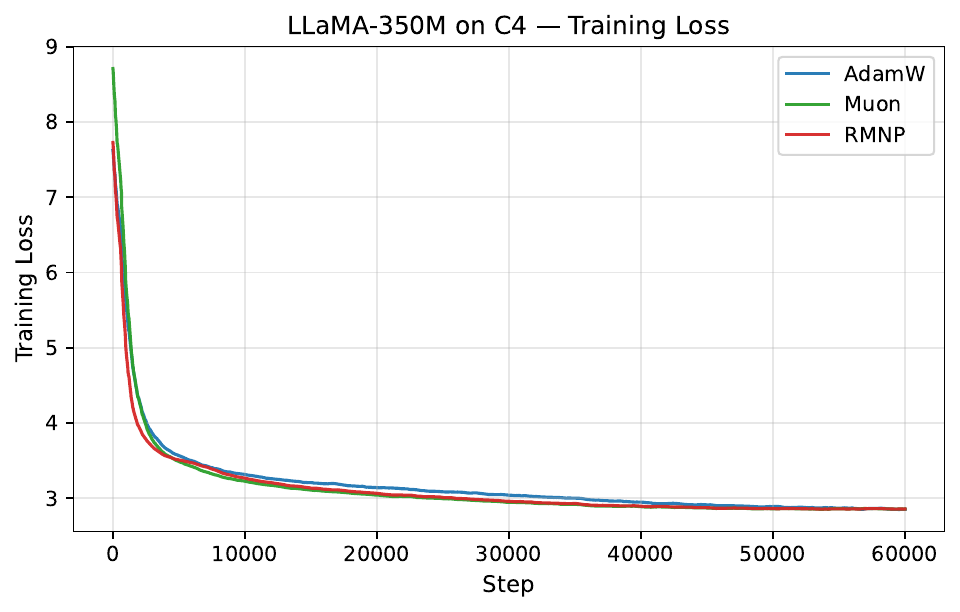
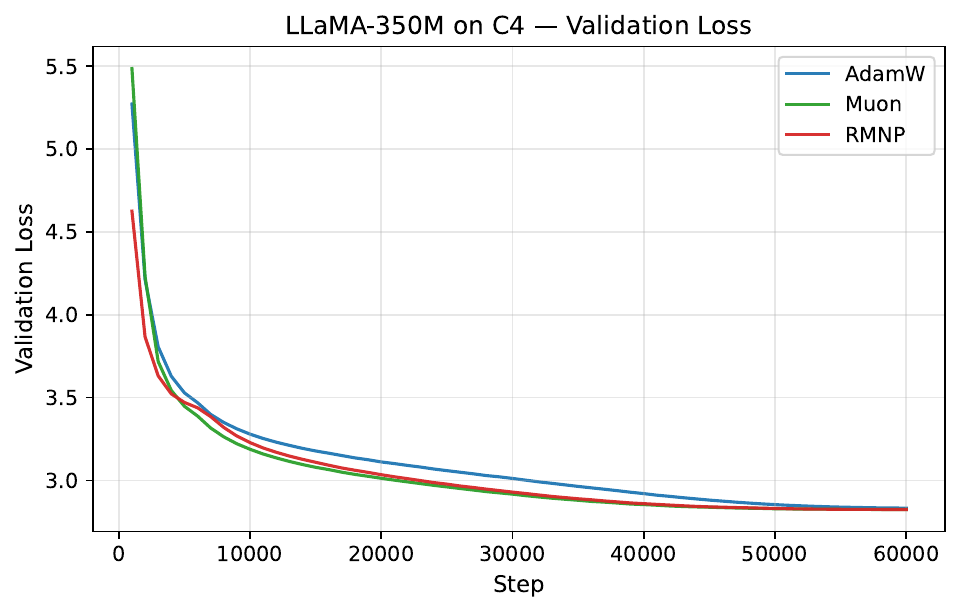
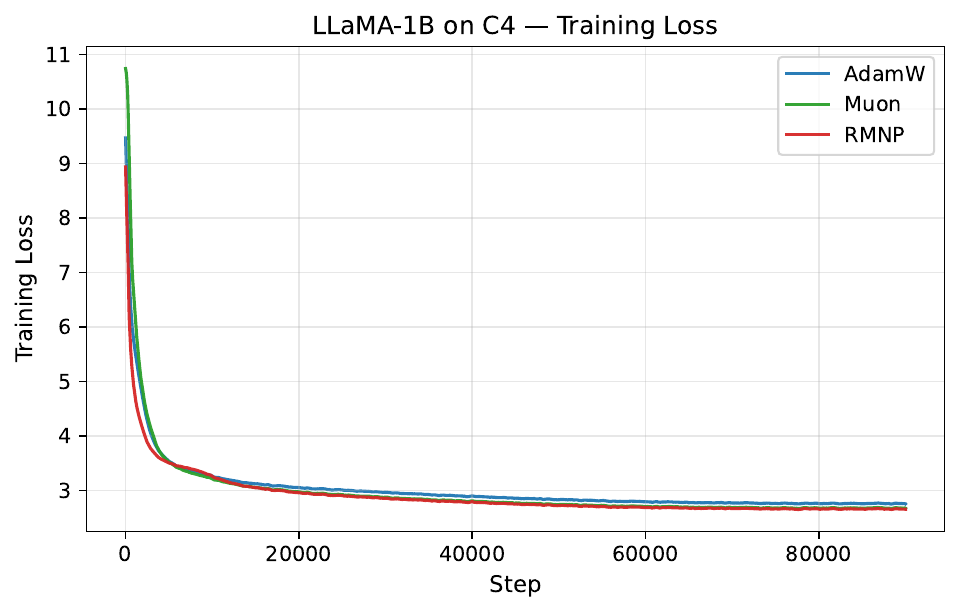
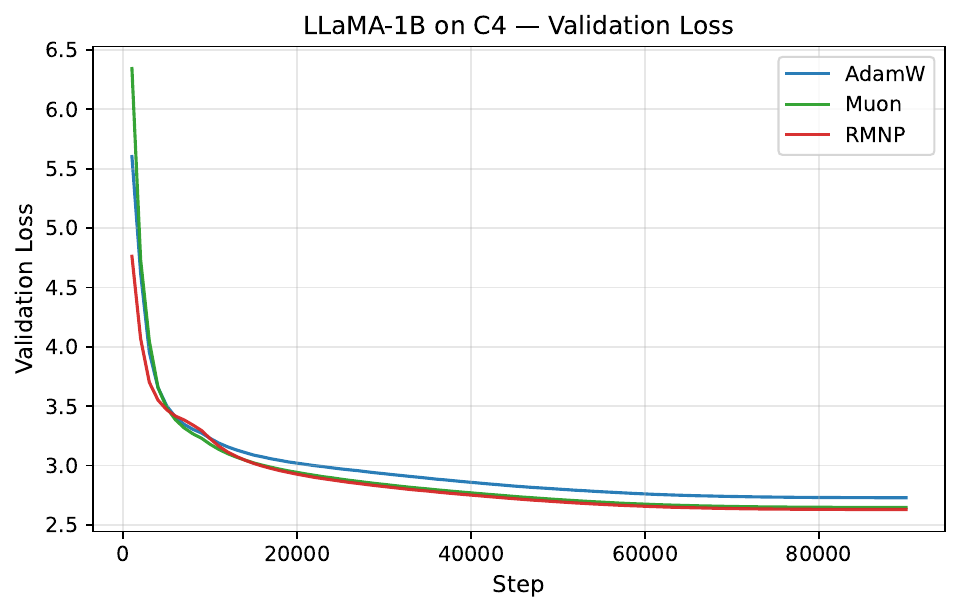
Per-step training and validation loss across all GPT-2 and LLaMA scales. Each panel compares AdamW, Muon, and RMNP. RMNP matches or slightly improves on Muon, and both clearly beat AdamW.
@inproceedings{deng2026rmnp,
  title     = {RMNP: Row-Momentum Normalized Preconditioning for Scalable Matrix-Based Optimization},
  author    = {Deng, Shenyang and Ouyang, Zhuoli and Pang, Tianyu and Liu, Zihang and
               Jin, Ruochen and Yu, Shuhua and Yang, Yaoqing},
  booktitle = {Proceedings of the 43rd International Conference on Machine Learning (ICML)},
  year      = {2026}
}
Companion theory (HiLD 2026 workshop): How Does Orthogonalization Adapt to the Neural-Network Hessian Structure? A Gradient Self Outer-Product Analysis at Initialization.